
THE MIDDLE EAST POWDER KEG EXPLODES
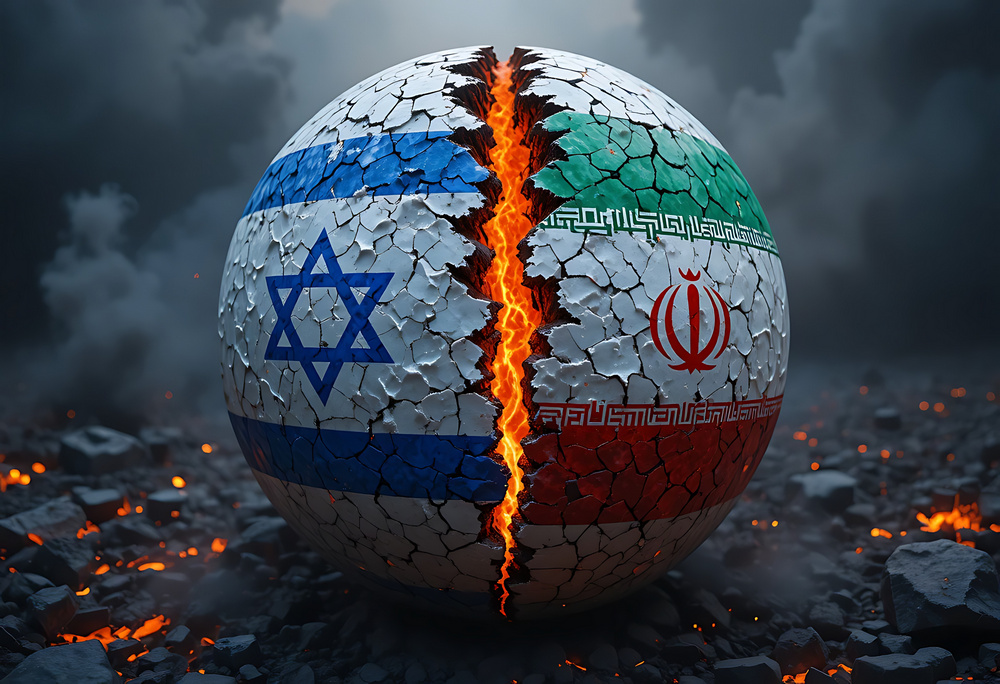 President Trump probably didn’t realise it, but when the United States joined Israel in an attack on Iran at the end of February,y he lit a fuse that caused the Middle East powder keg to explode, de and with it his ridiculous dream of getting the Nobel Peace Prize. Since then, every single country in the region — Iran, Kuwait, Saudi Arabia, the United Arab Emirates, Bahrain, Qatar, Oman, Jordan, Iraq, Yemen, Lebanon, Syria, Israel and even, on one occasion, Egypt — has been bombed. At stake has been control of the oil and natural gas resources of the region and the trade routes taking these and their by-products out to other parts of the world.
The Carter Doctrine
In his State of the Union message to Congress in January 1980, President Jimmy Carter read out what has since come to be known as the Carter Doctrine. It was a reaction to the Russian invasion of Afghanistan in 1979.
He set out the reasoning behind the doctrine:
‘The region which is now threatened by Soviet troops in Afghanistan is of great strategic importance: It contains more than two-thirds of the world’s exportable oil. The Soviet effort to dominate Afghanistan has brought Soviet military forces to within 300 miles of the Indian Ocean and close to the Straits [sic] of Hormuz, a waterway through which most of the world’s oil must flow. The Soviet Union is now attempting to consolidate a strategic position, therefore, that poses a grave threat to the free movement of Middle East oil.’
And concluded:
‘Let our position be absolutely clear: An attempt by any outside force to gain control of the Persian Gulf region will be regarded as an assault on the vital interests of the United States of America, and such an assault will be repelled by any means necessary, including military force’.
The United States had already built up, and paid for, the military power of Israel to be its proxy in the region. Following the overthrow of the self-styled Shah of Iran in 1979 in an ‘Islamic revolution’ which installed a hostile regime under Ayatollah Khomeini, Israel was the only powerfully armed state in the region that they could rely on. The US also had established a permanent military base in all the Gulf states except for Oman.
Taking out Iraq
In the end,d it wasn’t military action by Russia that led to the Carter Doctrine being activated. By the beginning of the 1990s, the state-capitalist regime there was collapsing, on the way to the final dissolution of the USSR in December 1991. It was the action of Iraq, whose leaders decided in August 1990 to invade and annex Kuwait to get free access to the Persian Gulf for its oil exports. This led to the First Gulf War in which Iraq was driven out of Kuwait by a United Nations-authorised coalition led by the US. The coalition stopped after driving Iraq out of Kuwait, leaving the Iraqi regime under Saddam Hussein still in power.
The US continued to regard the Iraqi regime as a threat to its interests in the region and in 2003 decided to finish the job on the pretext that Iraq was developing ‘weapons of mass destruction’, including nuclear ones. This time they didn’t get UN support, only that of Tony Blair’s Labour government. The Second Gulf War was a war of choice,r and Saddam Hussein was quickly overthrown. No WMDs were discovered, ed but a regime opposed to US control of the region had been eliminated.
This turned out to have an unintended consequence. The Saddam regime, which was Sunni Muslim, had repressed the Shia majority in the South as well as the Kurds in the North. With that regime gone, the exclusion of the Shia majority in Iraq ended, opening the way for the Shia Islamic regime in Iran to gain influence there. In short, it strengthened another regime that threatened US control of the Gulf.
The current line-up
Just as the US had established a string of bases in the Middle East, so in effect did Iran, made up of Shia militias in Iraq, Lebanon and Yemen. There are Shias in other Arab states. Bahrain has a Shia majority while Saudi Arabia’s oil fields are situated in a Shia majority area. Both dynastic regimes ruled by Sunni despots severely suppress any sign of Shia political activity.
The regime in Iran had always seen Israel as a key element in maintaining US domination of the Gulf, denouncing it as a ‘Zionist entity’ to be wiped off the map. This was couched in religious terms, but behind it were strategic considerations to do with control of the Gulf. Israel returned the compliment and regarded the Iran regime as an existential threat to be destroyed.
The scene, then, was set for any military confrontation. On the one side, the US with military bases in friendly Sunni Arab states and Israel as its (unruly) attack dog,g and, on the other, Iran with proxy Shia militias in Iraq, Lebanon and Yemen. Israel took the initiative in June last year when it bombed Iran, resulting in a twelve-day war between the two states, in which the US joined to bomb nuclear sites in Iran.
The pretext was that Iran was developing a nuclear bomb. That might or might not be true,ue but in terms of the principle of ‘might is right’ that governs relations between capitalist states, it wouldn’t be surprising if it was true. Iran would have an interest in having the Bomb just as the US would have an interest in it not having one. A nuclear Iran would shift the balance of power in the Middle East in its favour. Trump’s claim that if Iran had the Bomb it would use it on Israel is most likely nonsense, especially as Israel is a nuclear power too. States acquire nuclear weapons not necessarily to use them but more as a deterrent and to increase their might, and so their bargaining power, in relations with other states.
Better than the Bomb
At the end of February, Israel and the US again attacked Iran for the same reason. Again, this has had an unintended consequence. Iran discovered that it has a better bargaining chip than the Bomb and one which it could actually use — the capacity to disrupt traffic through the Strait of Hormuz, the trade route which, as Carter noted, vital exports for the world economy of oil and natural gas from the Gulf have to take. It has been used to its advantage. Trump has egg on his face while Israel is frustrated and may be tempted to have another go.
Socialists have always contended that wars break out when one side considers vital capitalist interests are at stake, over control of natural resources, trade routes, markets and investment outlets and strategic points and areas to acquire or protect these. The killings and destruction in the Middle East are a textbook confirmation of this.
ALB
Socialist Party
World Socialist Movement
Deja un comentario